|
|
|
|
 |
|
|
 |
 |
 |
 |
 |
 |
 |
 |
 |
Applications for RFID systems are
rapidly expanding as such systems find wide use
in mobile equipment, such as cellular phones, RFID
tags, non-contact IC cards, and more.
Market expansion is also predicted for such applications
as access control systems for IT security and commodity
distribution management systems for performing
inspections and inventory checks.
However, RFID systems have a weakness of failure
to communicate when there is a metal object present
next to the antenna. A high-performance magnetic
sheet that can solve this problem is needed. |
|
 |
 |
 |
The 13.56 MHz RFID system has a problem
with communication failure when a metal object
is nearby.
By using the RFN series, it has now possible to
use RF tags even over metal. |
 |
 |
 |
| Feature: |
Its
thinness (less than 0.2
mm) makes it ideal for compact
mobile equipment. |
|
|
|
| Feature: |
Realization
of high μ'
(approx. 50) and low μ''
(approx. 2) at 13.56 MHz
makes it possible for an
RFID system to communicate
over a long distance. |
|
|
|
 |
 |
 |
| Feature: |
The
roll format makes it easy
to combine with other rolls
(seals and labels). |
|
|
|
| Feature: |
Halogen-free,
ecological and compliant
with RoHS directive |
|
|
|
|
|
 |
| (Patent Number:3728320) |
 |
| Communication experiment
with 13.56 MHz band RFID system |
 |
 |
 |
| Although communication distance
in the free space is approximately 10 cm,
any metal object in the vicinity of a tag
will cause a communication failure. By using
a 150 μm-thick magnetic sheet, a communication
distance of up to 6 cm becomes possible even
if a metal object is close by. |
|
 |
 |
 |
| RFID Magnetic
Sheet |
 |
| ● |
Improving antenna
sensitivity for metal-resistant RFID tag (13.56
MHz) |
| ● |
Improving communication distance
from metal-resistance in Reader/Writer |
| ● |
One or both cards can now be
read when there are two non-contact IC cards
to be read |
|
|
 |
 |
 |
| Characteristics |
Standard
Type |
Roll
type |
| Type
Notation |
RFN1 |
RFN4 |
| Communication
Frequency (MHz) |
13.56 |
Magnetic
Permeability (13.56MHz) |
μ' |
50 |
42 |
| μ'' |
2 |
1 |
| Thickness (μm) |
100,150 |
50,100 |
| Surface
Resistivity (Ω/□) |
Over
104 |
| Usable
Temperature Range (°C) |
-25
to +100 |
-40
to +60 |
| Sheet
Dimensions |
200
mm × 300 mm |
200
mm (w) x 50 m (l) |
|
 |
* Please
contact us regarding thickness and format.
* This product is not
designed for use as a radio wave absorber.
* We strictly comply with
Japan’s security
and export control laws.
* Figures above are neither
standard nor guaranteed values. |
|
 |
 |
 |
 |
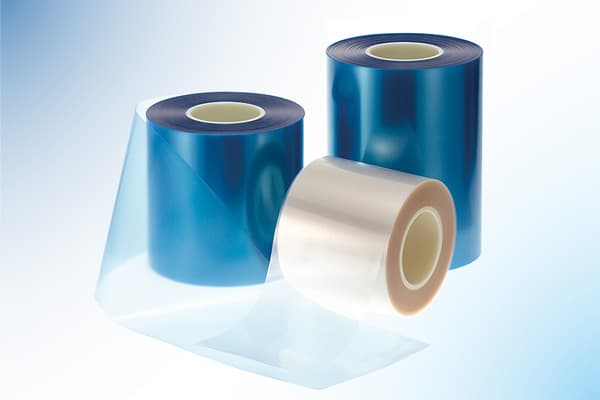
Sheet type example:
For [RFN1- 150μm thick, 200 mm x 300 mm size with 30 μm thick double-sided
adhesive tape, half-cut available] |
 |
 |
 |
Roll type example:
For [RFN4-100 μm thick, 50 mm width x 50 m length with 30 μm thick
double-sided adhesive tape] |
 |
 |
|
 |
 |
 |
| An example of
electromagnetic wave analysis (for 13.56 MHz
band RFID tag) |
 |
| <Tag Construction> |
 |
 |
 |
| ● |
Calculation
results for the coupling
characteristics between coil
antennas |
 |
| ● |
In the free
space, the tag and reader/writer
resonate at 13.56 MHz. |
 |
| ● |
Where a metal
object is present near a
tag, the resonance frequency
of the tag shifts greatly
in the high frequency end.
The graph shows that it shifted
to approximately 28 MHz.
The resonance frequency of
the reader/writer remains
at 13.56 Mhz. |
 |
| ● |
In this case,
if a magnetic sheet is used
near the tag as shown in
the figure above, resonance
frequency of the tag can
approach 13.56 MHz. |
 |
| ● |
It is possible
to optimize the resonance
frequency and Q value of
a tag antenna (coil) by selecting
the proper magnetic permeability
and thickness of a magnetic
sheet. |
|
|
|
|
 |
| <Result of electromagnetic
analysis> |
 |
 |
|
|
 |
 |
 |
 |
 |
| RFID wireless communication
becomes possible by magnetic flux penetrating
between two coil antennas. |
 |
 |
|
|
 |
 |
 |
| Eddy current occurs at
the metal in the vicinity of a tag,
caused by the Reader/Writer's magnetic
field. This magnetic field (demagnetizing
field) caused by the eddy current cancels
the magnetic filed necessary for communication. |
 |
 |
|
|
 |
 |
|
|
|
|
 |
 |
 |
|